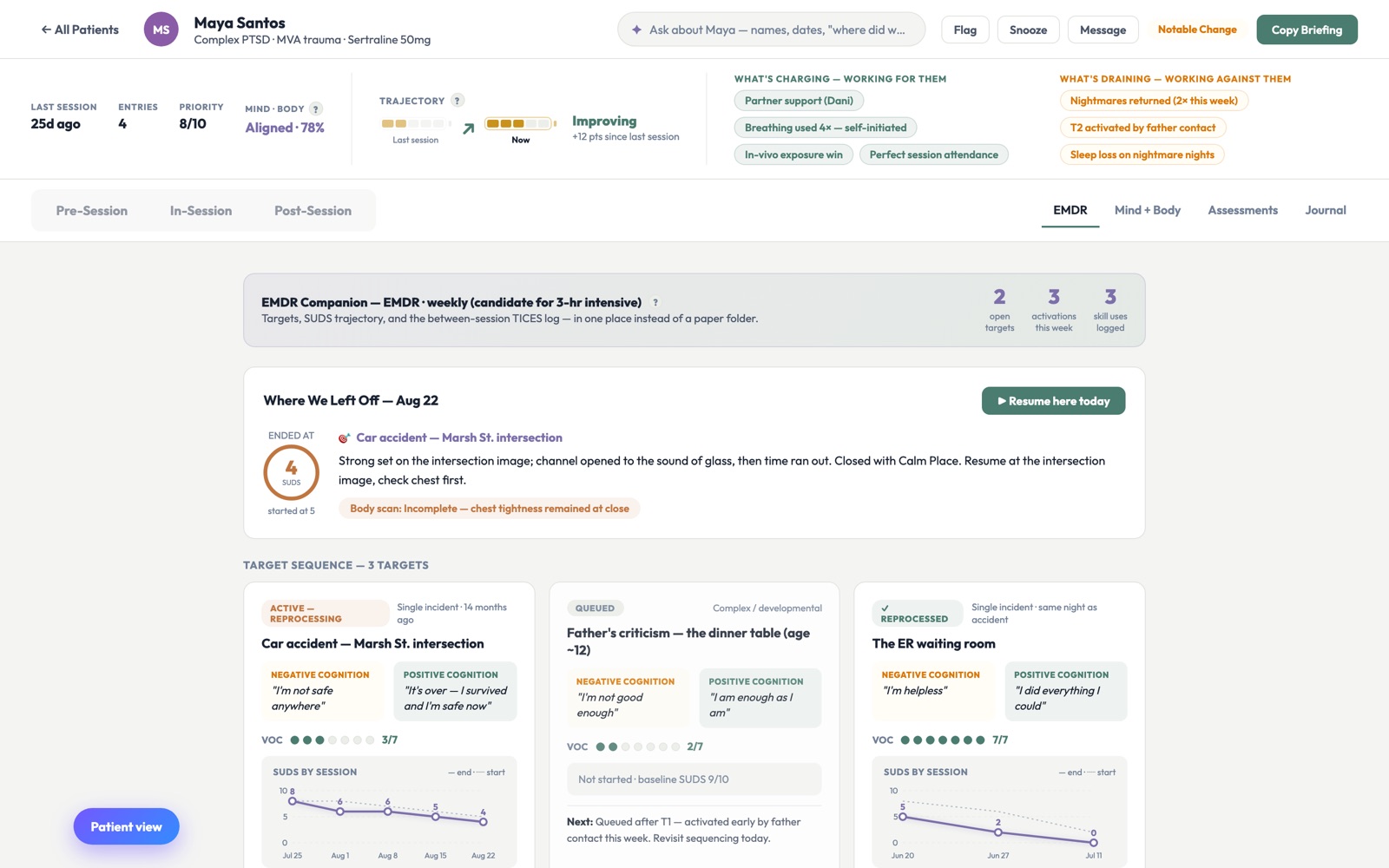
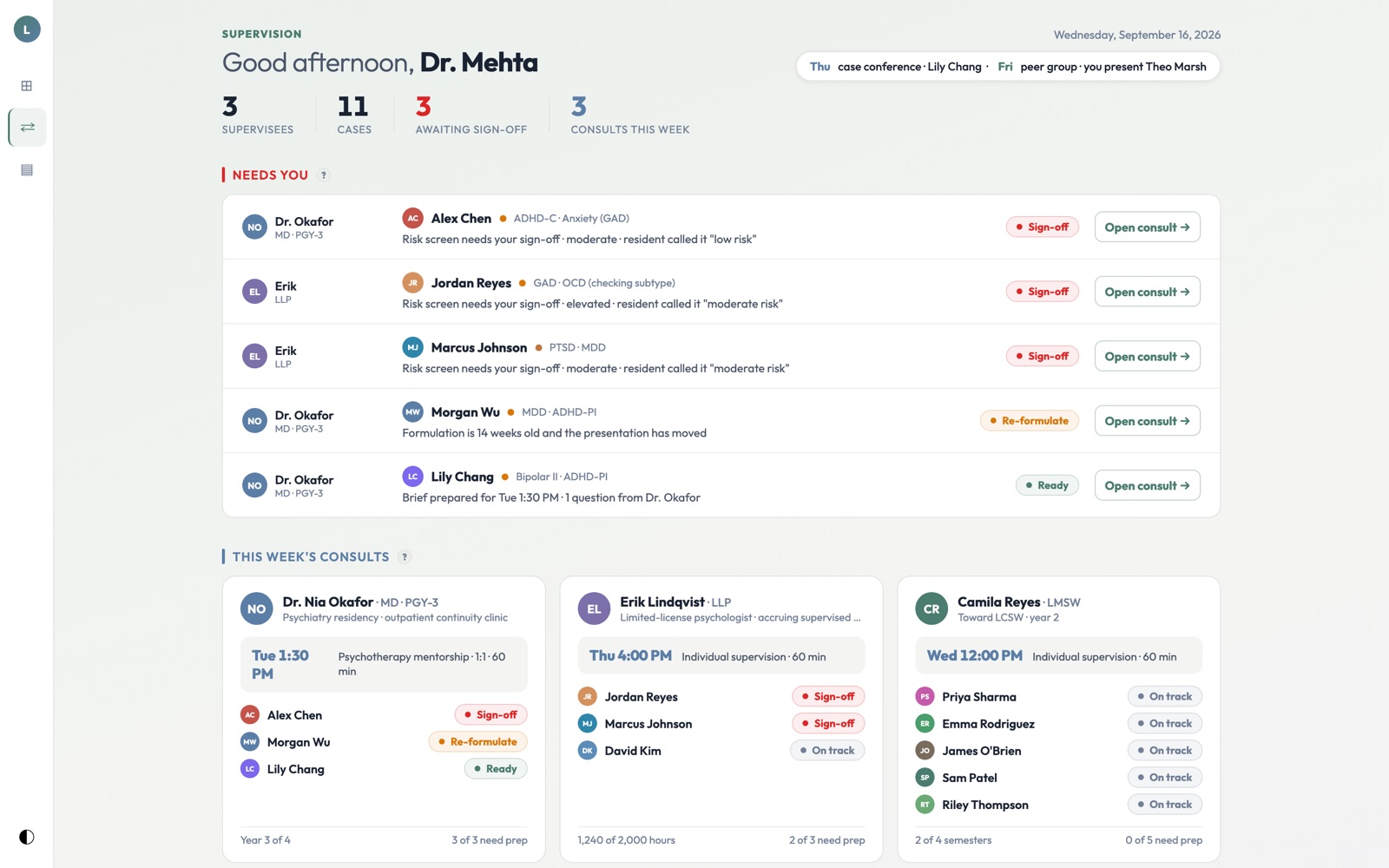
Lisner is a private voice journal your clients use between sessions. With their consent, you get a two-minute briefing before you meet. Nothing is recorded in the background, and your client decides what you see.
Your first month is free: one clinician, every client you invite. No card to start. BAA is part of signup. Founding practices pay $29 per clinician per month after that.


Sleep improved after Thursday. Two entries about the conversation with her sister. Asked to bring up work boundaries this week.

A fictional practice with simulated clients: the morning view, a pre-session brief, the client's journal, and a drafted note. Pick a time and Ash walks you through it, or email hello@lisner.ai for the access code to explore on your own.
Design partners use Lisner with clients in their own practices. Advisors hold us to what health systems and clinical programs require.

"I'm exploring how technology can thoughtfully support the therapeutic process while keeping the therapeutic relationship at the center of the work. Lisner helps bridge the gap between sessions — without getting in the way of it."
Founding design partner
"Every week I build a plan for a client with almost no idea what has happened since I last saw them. That is where most of the leverage in treatment is being lost — not in the hour, but in the other 167. Lisner takes that problem seriously and takes the clinician's judgment seriously at the same time."
Clinical advisorDr. Soma advises Lisner in her personal capacity. Her views are her own and do not represent Starr Commonwealth or any institution with which she is or was affiliated.

"What is unusual about Lisner is that patient consent and clinician judgment are design constraints rather than compliance afterthoughts. In my experience that is the difference between a tool that survives contact with a real practice and one that does not."
Medical advisory boardDr. Magu advises Lisner in his personal capacity. His views are his own and do not represent those of his employer or any institution with which he is affiliated.
"In behavioral health, so much lives in the space between visits. A tool that helps patients capture their lived experience in real time has the potential to bring more clarity, more continuity, and a deeper sense of being understood."
Program Director, Psychiatry Residency & Clinical Chair of Behavioral Health · Design partner under NDA
"After one of the hardest weeks of my life, I sat down with my therapist with everything to say, and couldn't find the words. Talking with friends in the neurodivergent community, I saw how common that is. Therapy is 50 minutes a week; life is the 167 hours in between. I built Lisner so no one has to walk in empty-handed again."
Introduce Lisner as a private place to think out loud between sessions. You invite them from your dashboard, and they connect in the app. No change to your workflow.
After a hard conversation, at 2am, on the walk home. The app transcribes on the phone. Nothing leaves the device until they choose to share it with you.
A one-page summary of themes, shifts, and anything your client flagged for you. Read it in two minutes. Works alongside any EHR.


Nothing changes in how you work. Your client installs a free app, speaks when something comes up, and decides what you see. Most clients understand it in one sentence.
Visibility into your client's week before they walk in: what they chose to share, what shifted, and what they asked to bring up. The session starts with the specific, not with "how was your week?"

Clinical demo · simulated clients and data

Clinical demo · simulated clients and data
Shared entries are grouped by theme and marked where the client's language shifts. You can open the full entry when it matters, and skim the rest. Search across weeks in seconds.
If your client chooses to share health data from their phone or a wearable, sleep and activity trends sit next to their entries for the same two weeks. It informs the session. It never replaces your judgment.

Clinical demo · simulated clients and data
"AI note-takers" and "mood apps" describe product categories generally. Capabilities vary by vendor.
Lisner works fully offline on the client's phone. Sharing is a single switch the client controls. Off means off.
HIPAA compliant · verified by Accountable HQTranscription and processing happen on the phone. Nothing leaves it until the client chooses to share.
The client controls sharing with a single toggle and can turn it off at any time.
When a client disconnects from you, your access ends and their shared data is deleted within 30 days.
Entries and health data are not used for advertising or to train AI models.
Lisner surfaces patterns. It informs your clinical judgment and never replaces it. Lisner is not a medical device.
A client who moves to you from another therapist can bring their history, or start fresh. Their data, their call.
You are charged per clinician, not per client, so a full caseload costs the same as a light one. Founding practices lock the lower seat rate.
See full pricing and what's included →Unlimited clients. BAA included.
Standard: $59 per clinician per month.
It is designed to give time back. Between sessions, Lisner does the organizing. Before a session, you read a short brief. Nothing is required of you between sessions.
Lisner requires no integration to start. You read briefings in the clinician portal and, when you document, copy a structured summary into whatever system you already use.
Entries stay on the client's phone until they choose to share one. Shared text is stored on HIPAA-eligible infrastructure with strict isolation between every client and clinician. Only you and your client can see what they shared.
Your access ends as soon as they disconnect, and their shared data is deleted within 30 days. They keep their own journal.
Yes. The Business Associate Agreement is part of the signup flow, before any client is invited.
That AI only summarizes the entries they chose to share with you, and never touches anything they keep private. The in-session script above is the one our design partners use.
Neither. Lisner is decision support that informs your clinical judgment. It is not a crisis service; the app routes anyone in crisis to 988, 741741, 911, and identity-affirming peer lines.
One clinician, every client you invite, no card to start. After the month, $29 per clinician at the founding rate. Ash sends your invitation within one business day.
Lisner's privacy and security program is verified by Accountable HQ. A Business Associate Agreement is in place with every clinical partner before a client is invited. Questions: privacy@lisner.ai.