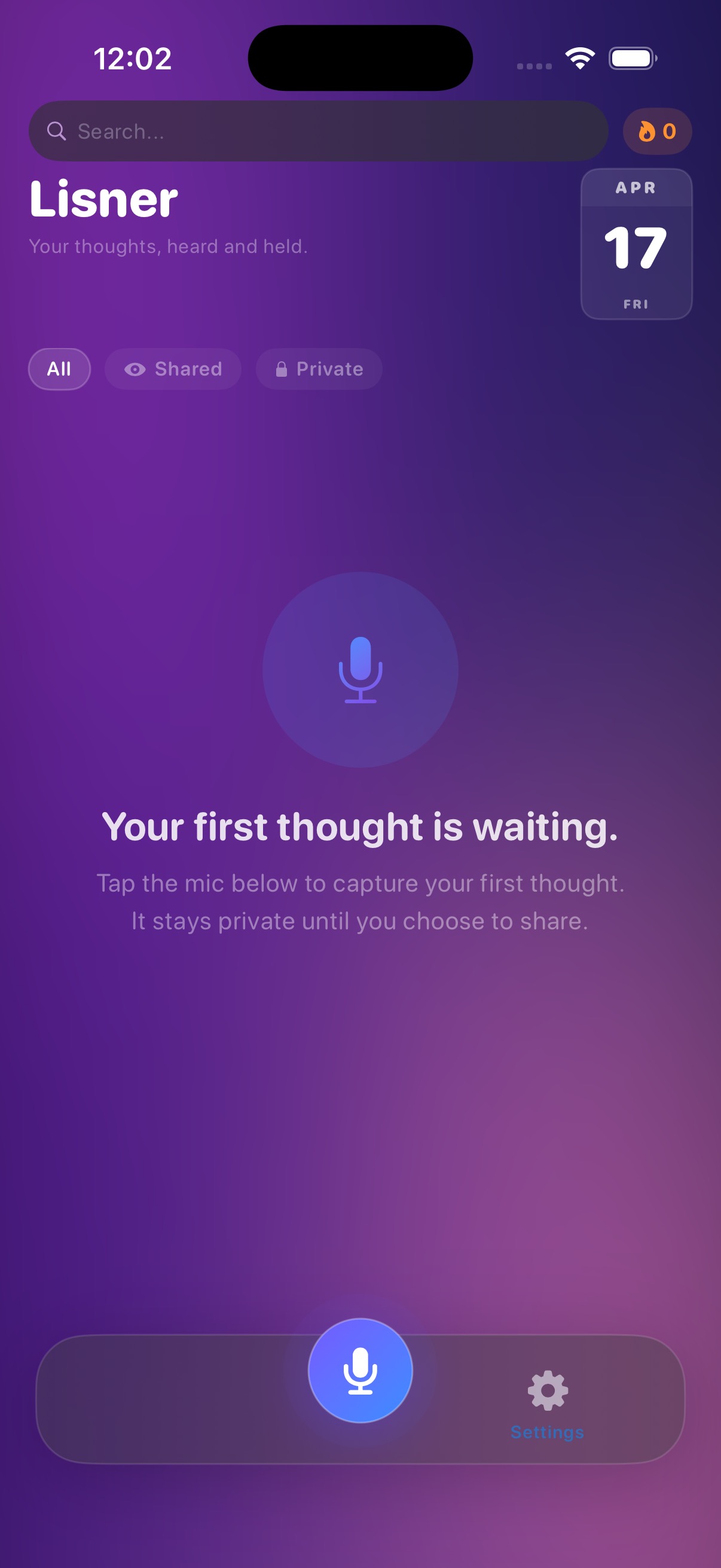
You see your therapist for one hour a week. Lisner is for the other 167. Speak your thoughts when they happen. They stay on your phone, and you choose what, if anything, to bring into the room.


Tap once and talk. Lisner transcribes on your phone and pulls out the key thought.
Over weeks, your thoughts sort into themes you can see. No worksheets, no streaks to keep up.
Lisner understands you in the language your thoughts arrive in. No translation, no switching.
Private on your device by default. You choose what to share, with whom, and you can change your mind.
Tap to captureHold the mic and talk. Stop when you're done. That's the whole routine.
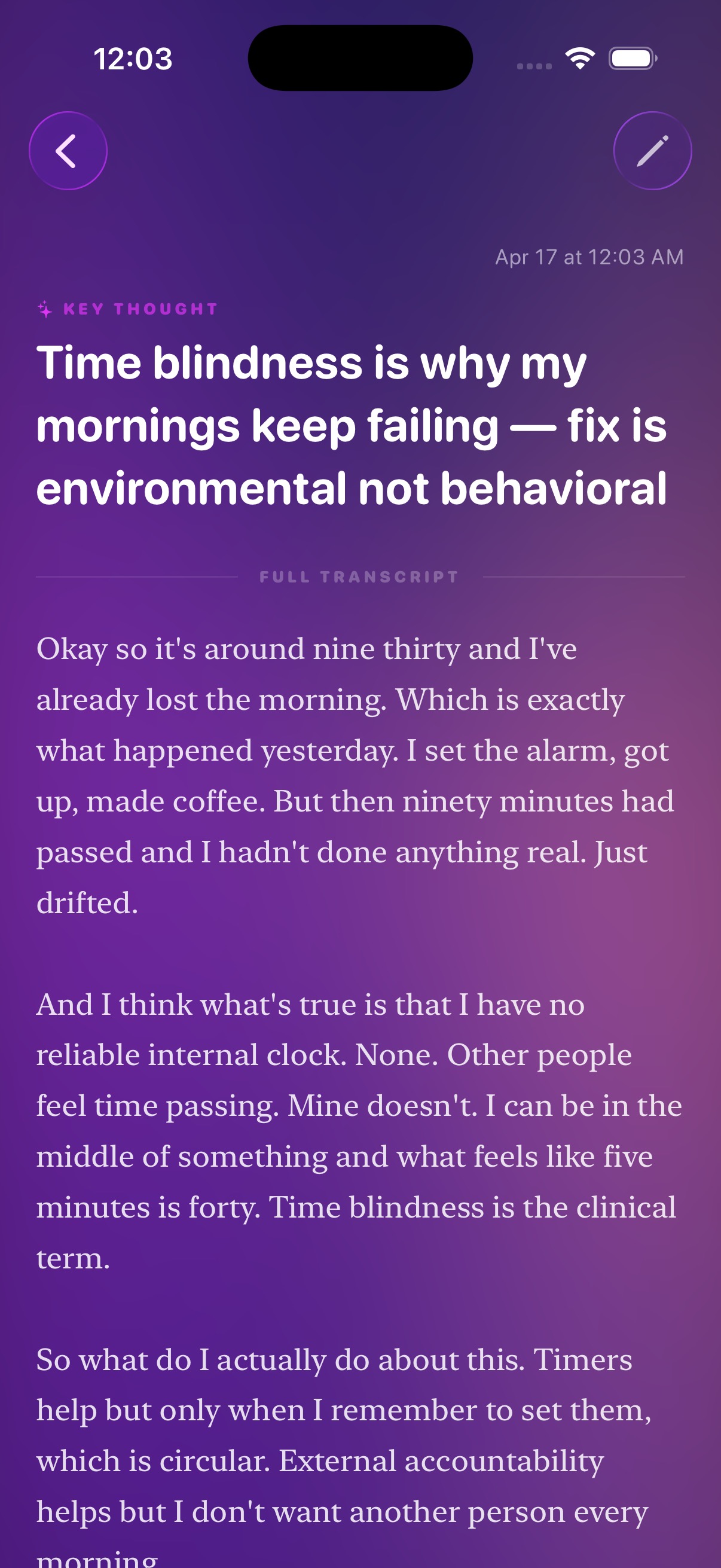
Full transcript + key thoughtEvery entry keeps your full words, with the one line that matters pulled to the top.
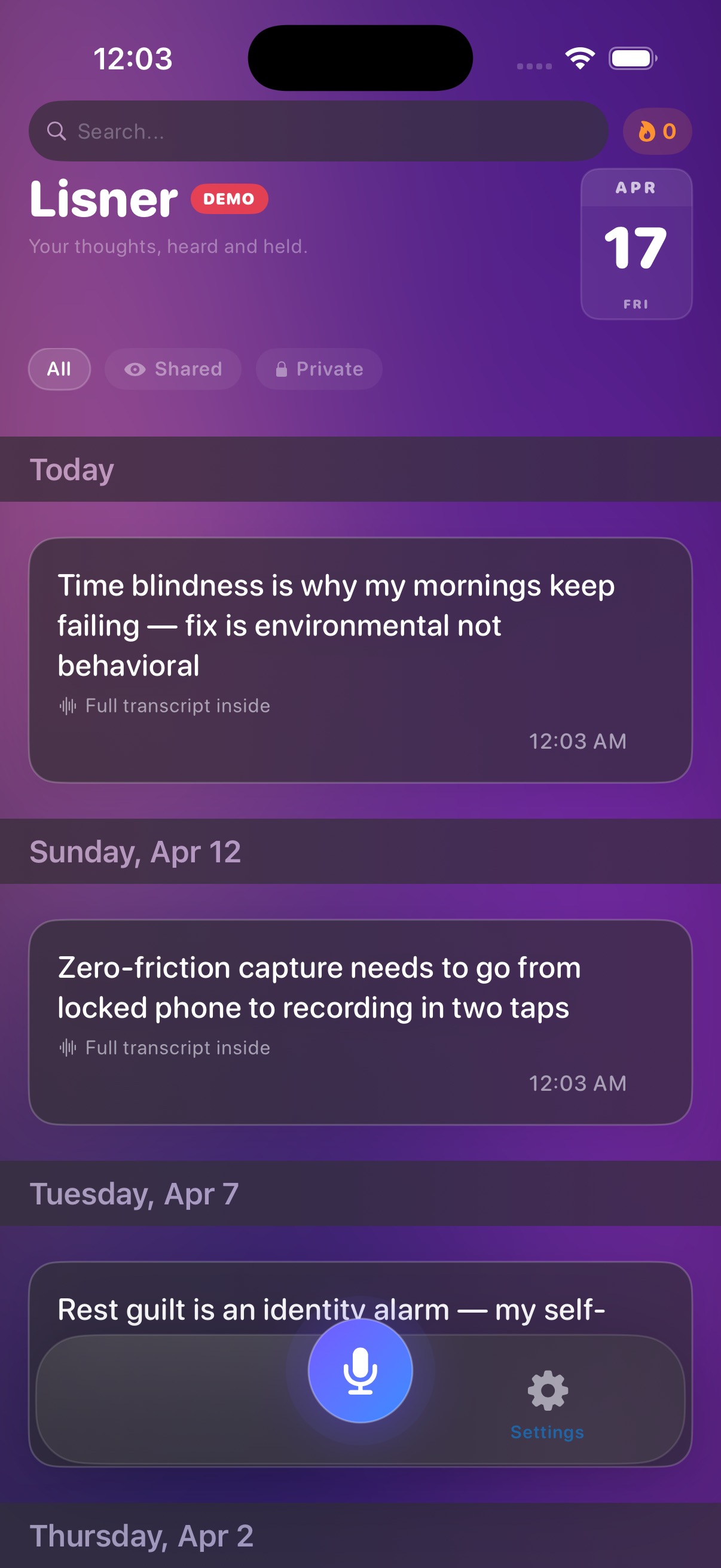
Your thought timelineScroll your week before a session and bring the things that actually mattered.
Privacy isn't a feature here. It's the foundation, because a mental health tool that isn't radically private isn't a tool.
Therapy runs on a 50-minute sample of a 10,080-minute week. Lisner gives the other 10,030 a place to land, not by tracking you, but by catching your own words when they arrive.
"I cancelled again today. Third time with the same friend. I keep telling myself I'll feel more like it next week and I'm starting to think next week is just a story I tell myself."
Captured in 11 seconds. On your device. Waiting for when you're ready.The quiet details, the moments you try to remember but can't fully reconstruct, the post-argument clarity. Lisner gives them a place to land, in your own words, the moment they arrive.
Switching therapists shouldn't mean starting over. Your thought history, themes, patterns, and insights, moves with you. One tap to share it with a new therapist, or start fresh. Your choice.
Your history lives on your device. It belongs to you, not your therapist, not us, not a health system.
Disconnect from one therapist, connect to another. Bring your full history, or start clean. One tap either way.
Export your data. Switch providers. Your mental health journey is yours to keep.

One tap sends them a note with what they need to get started. If they use Lisner, you can share your week with them before a session so you don't spend the first fifteen minutes catching up.
Lisner is shaped in active collaboration with licensed clinicians and clinical leaders. Design partners have direct input on what the product becomes, before it reaches the world.

"I'm exploring how technology can thoughtfully support the therapeutic process while keeping the therapeutic relationship at the center of the work. Lisner helps bridge the gap between sessions — without getting in the way of it."
Founding design partner
"Every week I build a plan for a client with almost no idea what has happened since I last saw them. That is where most of the leverage in treatment is being lost — not in the hour, but in the other 167. Lisner takes that problem seriously and takes the clinician's judgment seriously at the same time."
Clinical advisorDr. Soma advises Lisner in her personal capacity. Her views are her own and do not represent Starr Commonwealth or any institution with which she is or was affiliated.

"What is unusual about Lisner is that patient consent and clinician judgment are design constraints rather than compliance afterthoughts. In my experience that is the difference between a tool that survives contact with a real practice and one that does not."
Medical advisory boardDr. Magu advises Lisner in his personal capacity. His views are his own and do not represent those of his employer or any institution with which he is affiliated.
The highest-volume conditions in outpatient mental health. Design partners are actively reviewing the product for clinical accuracy and real-world fit.
Conditions where between-session blind spots carry the highest clinical risk. Advisory focus: safety, accuracy, and clinical trust.
Advisory members guide ongoing product development, with clinical accuracy and data safety reviewed in every release.
The app is free to download and use on your own. If your therapist uses Lisner, their practice covers the connection. You never pay to share with them.
No. Lisner works as a private voice journal on its own. Connecting a therapist is optional and can happen later, or never.
Only you, until you switch sharing on for a specific entry. Your therapist then sees that entry.
Yes. Recording and transcription happen on your phone. You only need a connection to share an entry with a therapist.
Not yet. Android is in development. Lisner is on iPhone today.
Lisner is not a crisis service. Call or text 988, text HOME to 741741, or call 911. The full list of lines, including identity-affirming peer lines, is one tap away inside the app and at the bottom of this page.

Free to start on iPhone. Android is in development.
Download on the App Store
Lisner's privacy and security program is verified by Accountable HQ. A Business Associate Agreement is in place with every clinical partner before a client is invited. Questions: privacy@lisner.ai.