Your therapist sees you for one hour a week. Lisner preserves the other 167.
Because sometimes you just need someone to listen. That's it.
Android is coming soon. Be the first to get it.
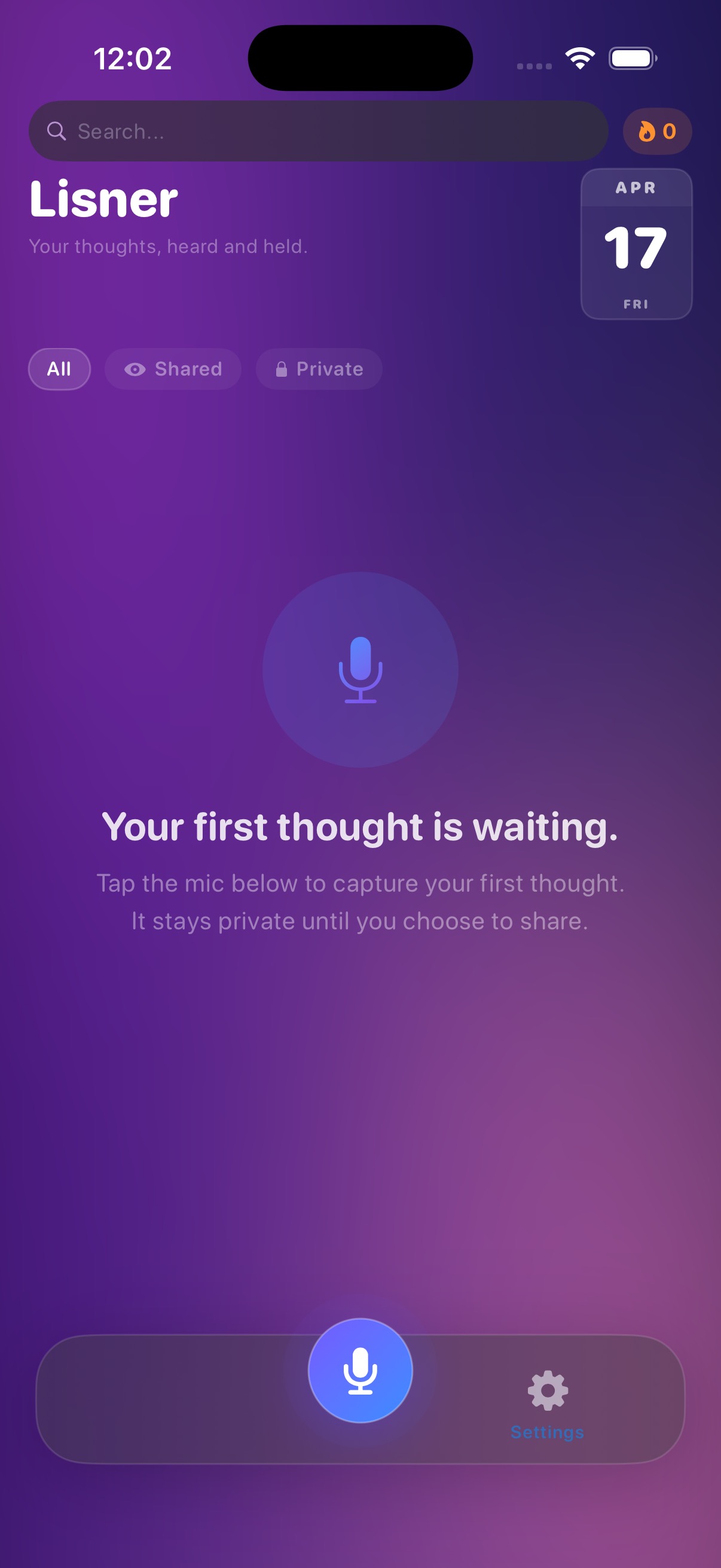
A voice-first thought capture that meets you wherever you are — 2am, post-argument, mid-commute. Private by default.
In behavioral health, so much lives in the space between visits — the quiet details, the moments you try to remember but can't fully reconstruct. The unfiltered weight of a 2am realization. The post-argument clarity that's gone by Friday.
Therapy is powerful. But it runs on a 50-minute sample of a 10,080-minute week. Lisner captures the other 10,030 — not by tracking you, but by giving your own words a place to land.
"I cancelled again today. Third time with the same friend. I keep telling myself I'll feel more like it next week and I'm starting to think next week is just a story I tell myself."
How it works
One tap. Say what's on your mind. Your words stay private — nothing is ever sent to a server without your choice.
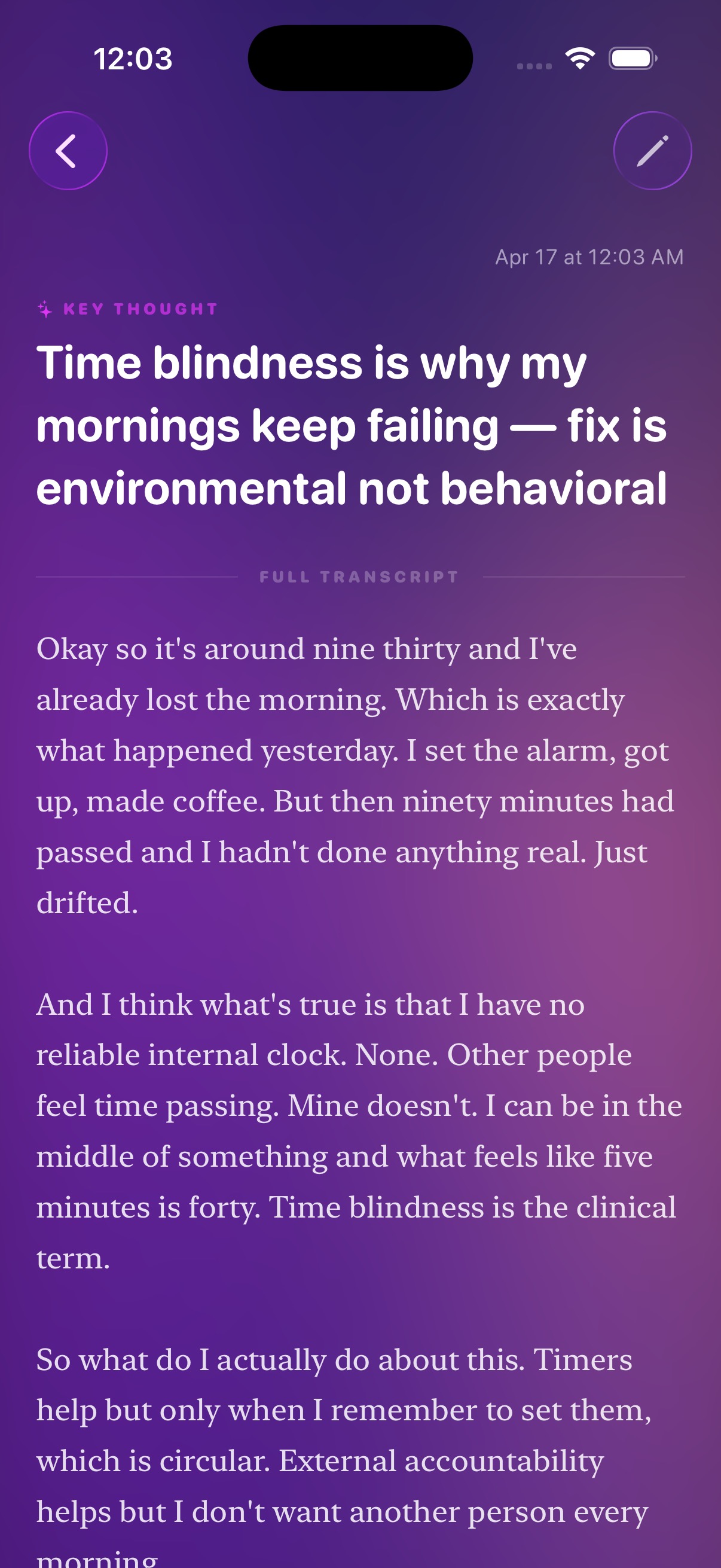
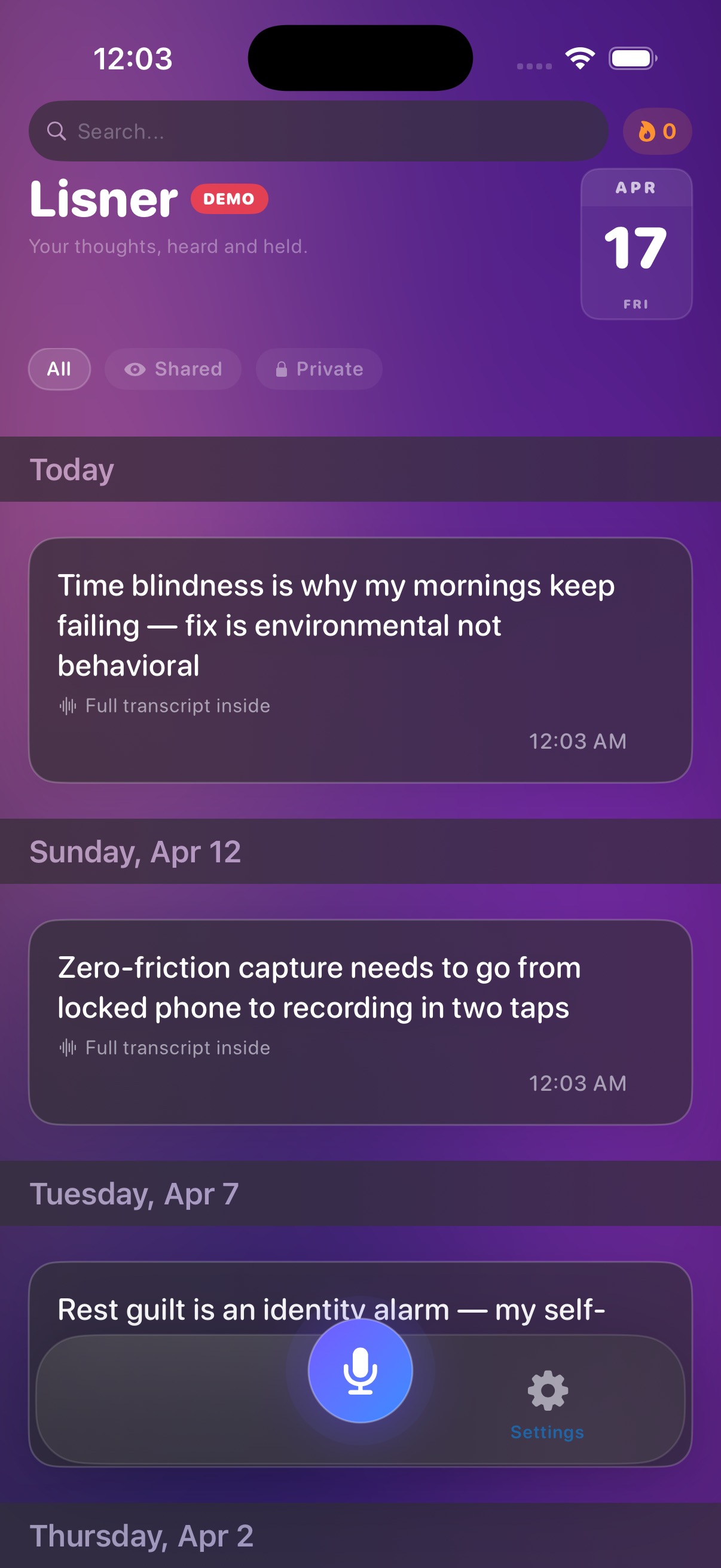
Your thoughts are organized automatically — by theme, emotional signal, what keeps returning. No categories. No homework.
Lisner understands you in the language your thoughts actually arrive in. No translation. No switching. No cognitive overhead.
Everything stays private on your device by default. You choose what to share, with whom, and you can change your mind at any moment.
Privacy isn't a feature. It's the foundation — because a tool for mental health that isn't radically private isn't a tool.
Most AI wellness apps send your words to the cloud to be processed, stored, and used to train models. Lisner doesn't. Your voice is transcribed and understood on your device — nothing leaves it until you choose to share. That's a difference of architecture, not policy.
No passive collection. Lisner only captures what you actively choose to record. Nothing runs in the background — ever.
Your voice never leaves your device. Transcription happens completely offline. Your text transcripts are stored locally and in your private iCloud backup—we have zero access unless you explicitly share with a care provider.
You control what's shared. If you ever want to share a thought with someone you trust — it's your choice. And you can change your mind instantly.
Delete is permanent. When you delete a thought, it is immediately deleted from your device and synced out of your private iCloud. We keep no backups.
Switching therapists shouldn't mean starting over. With Lisner, your thought history — themes, patterns, insights — moves with you. It's always your choice.
Your thought history lives on your device. It belongs to you — not your therapist, not us, not a health system.
Disconnect from one therapist, connect to another. Your full history moves with you.
Your progress isn't trapped in someone else's system. Export your data. Switch providers. Your mental health journey is yours to keep.
One tap sends them a note with everything they need to get started.
Lisner is being shaped in active collaboration with licensed clinicians across ADHD, anxiety, depression, trauma, and bipolar specialties. Early design partners have direct input on what the product becomes — before it reaches the world.
"I'm exploring how technology can thoughtfully support the therapeutic process while keeping the therapeutic relationship at the center of the work. Lisner helps bridge the gap between sessions — without getting in the way of it."
"Almost everything in this field is built to track what is wrong. What interested me about Lisner is the room it leaves for what is going right — the people, the routines, and the experiences that are actually helping a particular person. That is information a clinician can use, and it is information a client can be proud of."
"Lisner gives the clinician something to begin from instead of a blank page. That sounds like a small change. Over a course of treatment it is not."